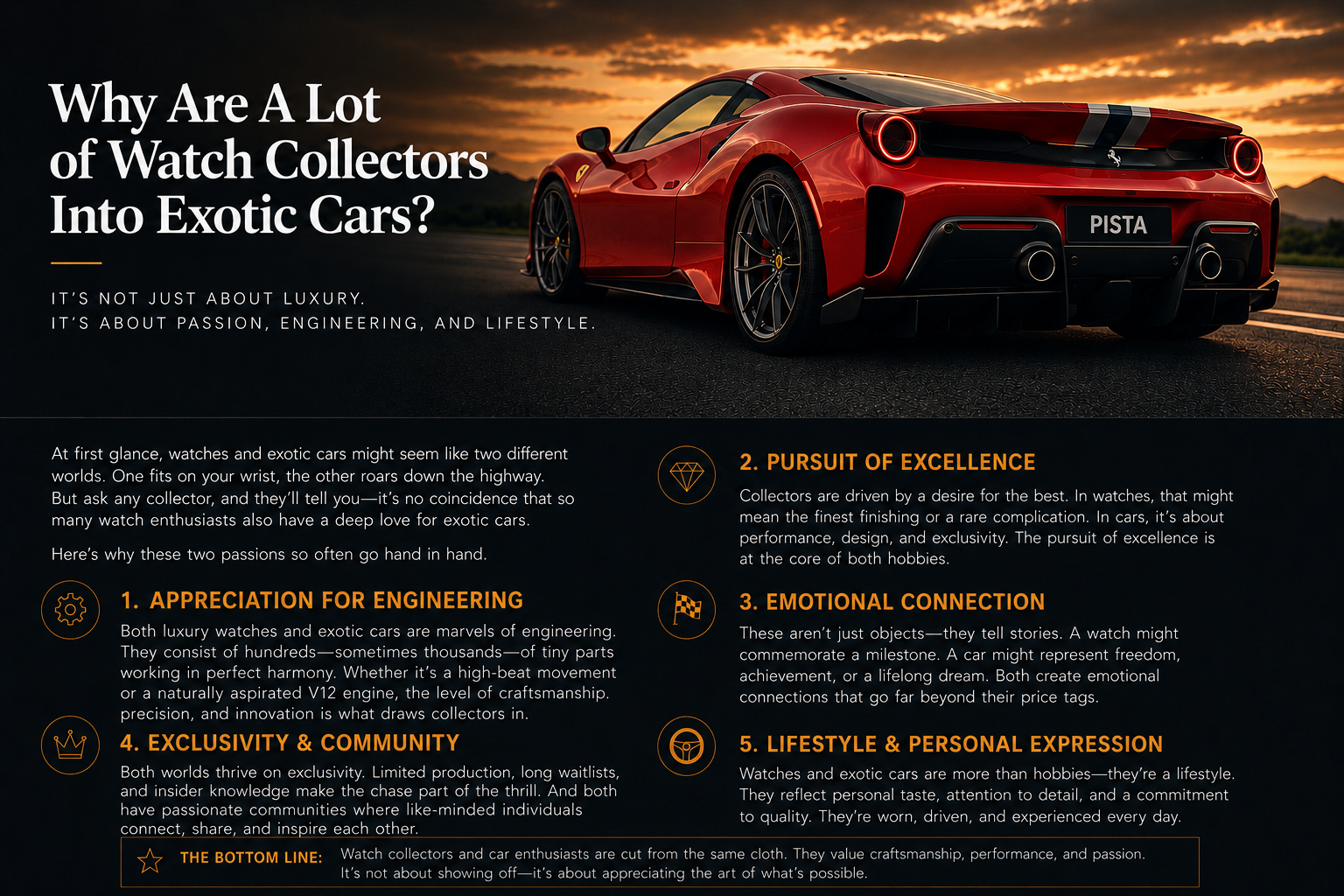
There has always been a strong connection between luxury watches and exotic cars. Walk into a high end watch event, a collector meetup, a Formula 1 paddock, or an upscale automotive rally, and the overlap becomes immediately obvious. The same individuals discussing a ceramic Rolex Daytona or an Audemars Piguet Royal Oak Offshore are often the same people debating Ferrari allocations, Porsche GT cars, or the sound of a naturally aspirated Lamborghini V12.
To outsiders, the relationship may appear surface level expensive watches paired with expensive cars. However, for serious collectors, the connection goes far deeper than luxury alone. Both worlds are built around engineering, heritage, exclusivity, design language, emotional experience, craftsmanship, scarcity, and the relentless pursuit of mechanical perfection.
The overlap between watch collecting and exotic car culture is far from accidental. The two industries evolved alongside one another for decades, continuously influencing each other through motorsports, innovation, performance engineering, and status signaling. Many of the same psychological drivers that attract someone to mechanical watches also attract them to high performance automobiles. For many enthusiasts, watches and cars ultimately represent two sides of the same obsession.
Mechanical Art That Serves a Purpose One of the biggest reasons collectors gravitate toward both hobbies is an appreciation for mechanical engineering. Luxury watches are miniature mechanical machines worn on the wrist, while exotic cars are large scale mechanical masterpieces designed for speed, handling, and emotion. In both cases, collectors admire the complexity hidden beneath the surface. A watch enthusiast understands the beauty of a movement operating with hundreds of tiny components working in perfect synchronization. Similarly, a car enthusiast appreciates the engineering behind a flat plane crank V8, a dual clutch transmission, or advanced suspension geometry. Neither hobby is purely about practicality.
Most collectors know there are cheaper and more efficient ways to tell time than wearing a $20,000 Swiss mechanical watch, just as there are far more practical ways to travel than owning a Ferrari or McLaren. The appeal comes from emotional connection. Collectors appreciate the craftsmanship, the precision, and the human engineering required to create something extraordinary. A mechanical watch and an exotic car both represent a celebration of engineering in an increasingly digital world.
Passion Over Pure Logic Watch collectors and exotic car owners tend to think emotionally rather than purely financially. No enthusiast buys a hand finished chronograph or a V10 Lamborghini because it is the logical option. These purchases are passion driven. They create excitement, anticipation, and personal satisfaction. Collectors often describe the experience in remarkably similar ways. A watch enthusiast may talk about the feeling of putting on a vintage Rolex GMT Master before a trip or hearing the smooth winding of a Patek Philippe movement. A car collector may describe the startup sound of a Porsche GT3 RS or the experience of driving an analog Ferrari through mountain roads.
Both hobbies create emotional rituals where the process matters just as much as ownership itself. The research, the hunt, the acquisition, the maintenance, the customization, and the stories behind each piece all become part of the experience. Many collectors enjoy discussing references, production years, rare configurations, and historical significance almost as much as using the item itself.
Exclusivity and Scarcity Drive Demand Scarcity plays a massive role in both luxury watches and exotic cars. The modern collector market thrives on limited production, allocations, discontinued references, and rare specifications. In the watch world, collectors chase pieces like the Rolex Daytona, Patek Philippe Nautilus, or Audemars Piguet Royal Oak because supply is intentionally limited relative to demand. Certain dial configurations, bezel combinations, and production years become especially desirable.
The exotic car market operates in a very similar way. Manufacturers like Ferrari and Porsche often limit production of high demand models, and some vehicles are only available to established clients with purchase history. Special editions become highly collectible because of rarity, production caps, or historical significance.
Collectors are naturally attracted to items that few people can access. This exclusivity creates prestige, but it also creates community. Owners and collectors feel connected through shared knowledge and appreciation. Being able to recognize a rare watch reference or a limited production exotic car signals expertise within the collector world.
Heritage and Storytelling Matter Another major reason for the overlap is the importance of history and storytelling. Luxury watches and exotic cars are deeply rooted in heritage, and collectors are rarely buying only the object itself they are buying the story behind it.
A Rolex Daytona carries decades of motorsport history tied to endurance racing and the Daytona International Speedway. TAG Heuer built much of its identity around Formula 1 and racing chronographs, while Omega became associated with space exploration and precision timing. Exotic automotive brands carry similarly rich narratives. Ferrari represents racing pedigree and Italian passion. Porsche symbolizes engineering precision and motorsport dominance. Lamborghini built its reputation around dramatic design and rebellious performance.
Collectors love stories. They enjoy understanding how a specific watch reference evolved over time or why a certain car model became legendary. Historical context creates emotional value far beyond the physical product itself. That storytelling element is a major reason enthusiasts naturally move between both worlds. Both Worlds Reward Attention to Detail Collectors are detail oriented by nature. The same person who notices the subtle difference between a ceramic bezel insert and an aluminum bezel insert on a Rolex GMT Master will likely notice the distinction between carbon ceramic brakes and steel brakes on an exotic car. Details matter.
Watch enthusiasts analyze case finishing, dial textures, bracelet taper, movement architecture, lume coloration, and production variations. Car enthusiasts analyze exhaust notes, wheel specifications, stitching patterns, suspension tuning, engine characteristics, and paint options.
This deep appreciation for details creates endless depth within both hobbies. There is always more to learn, and that constant learning process keeps collectors engaged for years. Status and Success Signaling There is also a social component that cannot be ignored. Luxury watches and exotic cars have historically represented achievement and success. For many entrepreneurs, executives, athletes, entertainers, and business owners, these items become personal rewards tied to milestones. The first Rolex. The first Porsche. The dream Ferrari. The rare Patek Philippe. These purchases often symbolize years of hard work and professional growth.
However, serious collectors usually move beyond status alone. At the highest levels, the focus becomes more about passion, curation, rarity, and appreciation rather than simply displaying wealth. Experienced collectors can often spot someone who genuinely understands the hobby versus someone who simply wants recognition. Knowledge itself becomes part of the status.
Motorsport and Watchmaking Have Always Been Connected The relationship between watches and cars became even stronger through motorsports. For decades, watch brands partnered directly with racing teams, drivers, and automotive manufacturers.
Chronograph watches became essential tools in racing environments before modern digital systems existed. Timing laps, calculating speed, and measuring performance all relied heavily on precision mechanical timekeeping.
This connection helped shape some of the most iconic watches in history. The Rolex Daytona, TAG Heuer Monaco, Omega Speedmaster Racing, and Breitling chronographs all carry strong motorsport DNA. Today, many luxury watch brands maintain active partnerships with automotive companies. Richard Mille works closely with Formula 1 drivers and racing teams. TAG Heuer partners with Porsche. Breitling collaborates with Bentley. Hublot has worked with Ferrari. These collaborations reinforce the shared audience between both industries.
Collectors appreciate the crossover because the philosophies are remarkably similar precision, performance, speed, engineering, and innovation.
Analog Experiences in a Digital World One of the most overlooked reasons for the overlap is the desire for analog experiences. Modern life is increasingly digital, automated, and software driven, while luxury watches and exotic cars offer something entirely different.
They provide tactile, mechanical experiences. A mechanical watch contains moving gears, springs, and balance wheels that can physically be seen and appreciated. An exotic car provides engine sound, steering feedback, vibrations, and driver engagement. Collectors often describe both hobbies as escapes from digital monotony. They enjoy interacting with objects that feel mechanical, authentic, and alive. This is especially true among younger collectors entering the luxury space today. Many younger enthusiasts intentionally gravitate toward mechanical products because they feel more personal and emotional than fully digital alternatives.
The Community Aspect Is Extremely Strong Both hobbies also thrive because of community. Watch collectors and exotic car owners naturally gather around shared interests because cars and watches create conversation. Collectors enjoy attending rallies, concours events, track days, watch meetups, private collector dinners, and luxury lifestyle gatherings. These communities often overlap heavily. It is extremely common to see luxury watch brands sponsoring automotive events or exotic car dealerships hosting watch showcases.
The shared culture creates networking opportunities, friendships, business relationships, and memorable social experiences. For many collectors, the community becomes just as valuable as the products themselves.
Investment Potential Also Plays a Role While passion usually comes first, many collectors recognize that both watches and exotic cars can hold value exceptionally well. Certain rare watches and limited production exotic cars have appreciated dramatically over time.
Collectors understand that buying quality pieces with strong historical significance and limited production can create long term value retention. This adds another layer of excitement. The idea of owning something emotionally rewarding that may also appreciate financially creates a compelling combination.
However, the strongest collectors rarely buy purely for speculation. The most respected enthusiast stypically buy what they genuinely love. Passion driven collecting almost always creates better long term collections than trend chasing.
Why the Relationship Will Continue The connection between luxury watches and exotic cars is unlikely to disappear because both industries appeal to remarkably similar personality types. They attract people who appreciate craftsmanship, individuals obsessed with engineering, collectors who value exclusivity, enthusiasts drawn toward heritage and storytelling, entrepreneurs who enjoy achievement driven rewards, and individuals seeking analog experiences in a digital era.
As luxury markets continue evolving, the overlap between these worlds may become even stronger. Modern collectors increasingly view watches, cars, fashion, architecture, and travel as part of one broader lifestyle centered around design, experience, and personal passion.
For true enthusiasts, a luxury watch and an exotic car are not simply products. They are emotional machines. Both represent artistry, engineering, history, and individuality. That is why so many collectors who fall in love with one inevitably become fascinated by the other.
At the highest level, both hobbies are ultimately driven by the same thing: a deep appreciation for beautifully engineered mechanical art.